
Quick answer: Hypotonic solutions have a lower effective solute concentration than cells and drive net water movement into cells; hypertonic solutions have a higher effective solute concentration and draw water out of cells. Isotonic solutions produce no substantial net shift of water across the cell membrane. In clinical practice, fluid choice also depends on the patient’s physiology, indication, electrolyte results and the solution’s composition.
Hypertonic vs hypotonic vs isotonic: key differences
- Hypotonic solution
- Relatively fewer effective dissolved particles outside the cell. Water moves into cells, which tend to swell. Example: 0.45% sodium chloride is commonly classified as hypotonic.
- Isotonic solution
- Similar effective tonicity to plasma. No major net water shift between extracellular fluid and cells. Example: 0.9% sodium chloride; balanced crystalloids are generally used for isotonic fluid replacement.
- Hypertonic solution
- More effective dissolved particles outside cells. Water moves from cells into extracellular fluid, and cells tend to shrink. Example: 3% sodium chloride is a hypertonic saline preparation used only for specific clinical indications under careful monitoring.
Diagram: how osmosis changes cell size
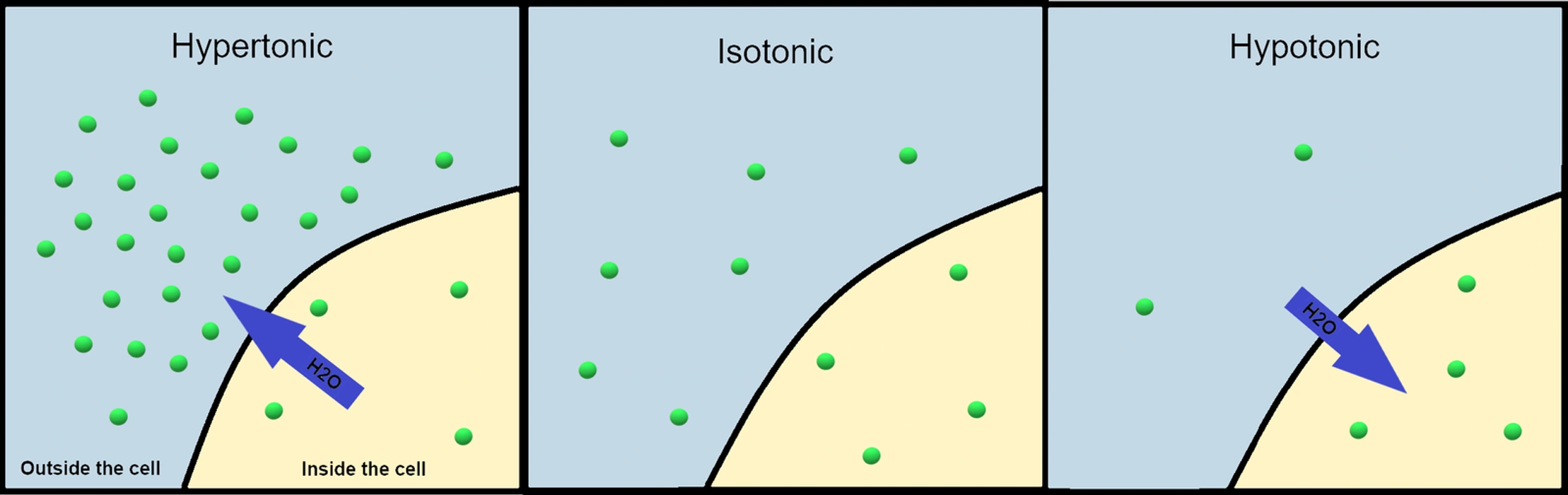

- Hypotonic environment: outside water → cell; cell swells
- Isotonic environment: water ↔ cell; no net size change
- Hypertonic environment: cell → outside water; cell shrinks
Arrows show net osmotic movement. Actual cells, capillary membranes and infusion solutions have more complex physiology.
What is the difference between osmolarity and tonicity?
Osmolarity represents the concentration of osmotically active particles in a solution. Tonicity describes the effect of relatively non-penetrating solutes on sustained water movement and cell volume. Two infusions with similar measured osmolarity do not necessarily have the same lasting tonicity once their ingredients distribute or are metabolised. This is why dextrose-containing solutions require particular care in fluid-classification questions.
Common IV solution examples
| Solution | Teaching classification | Key distinction |
|---|---|---|
| 0.9% sodium chloride | Isotonic | No substantial sustained cell-water shift; fluid distributes through extracellular spaces. |
| 0.45% sodium chloride | Hypotonic | Favours water movement into cells. |
| 3% sodium chloride | Hypertonic | Favours water movement out of cells; use requires a specific prescription and monitoring. |
| 5% dextrose in water (D5W) | Often taught as isotonic in the bag; physiologically hypotonic after glucose metabolism | The starting solution and its later effect are different questions. |
Is D5W isotonic or hypotonic?
Distinguish the bag from the body. Some product labels call D5W isotonic; another 5% dextrose product label reports a calculated osmolarity of 252 mOsm/L and calls it slightly hypotonic. Check the actual product instead of treating every classroom label as an exact measurement.
Once glucose is taken up and metabolised, D5W supplies water without electrolytes and has a hypotonic effect. The prescribing information specifically warns about this physiological change and the need to monitor sodium. A dextrose-and-saline mixture also contains sodium chloride, so do not assume every fluid containing 5% dextrose behaves like D5W.
Revision check: A question describes D5W after glucose metabolism. Calling it persistently isotonic overlooks the change in composition. Explain what remains, then predict the direction of water movement; the word “dextrose” alone is not enough.
Nursing assessment and clinical caution
Before, during and after IV-fluid administration, nurses consider the prescription, clinical indication, fluid balance, vital-sign trends, neurological changes, respiratory status, renal function, serum sodium and other relevant laboratory trends. Dextrose-containing fluids also require attention to blood glucose. Report headache, confusion, seizures, new breathlessness or signs of fluid overload promptly in accordance with local escalation protocols. Link respiratory findings to the wider assessment; our lung-sound comparison explains how to describe sounds without using them alone to diagnose a cause.
Clinical caution: Hypertonic saline and correction of sodium disorders carry important neurological risks. This article does not provide infusion rates, sodium-correction targets or prescribing recommendations. Patients require individualised treatment and current institutional protocols.
Worked nursing student scenario
A patient receiving a prescribed IV fluid becomes newly confused. Rather than assuming the bag is the cause, a student should assess the patient promptly, check the actual prescription and fluid being administered, observe neurological and respiratory findings, review available sodium trends, and escalate immediately. Fluid tonicity helps explain a possible mechanism; it does not independently establish a diagnosis.
Short questions and explained answers
- Which solution tends to move water into cells? A hypotonic solution, because the surrounding effective solute concentration is lower.
- Why is 3% sodium chloride hypertonic? Its effective solute concentration exceeds that of plasma and may draw water out of cells.
- Does isotonic mean that the infused fluid stays exclusively inside blood vessels? No. Isotonic crystalloids distribute in the extracellular compartment, not solely the intravascular space.
- Does water stop moving in an isotonic solution? No. Water moves in both directions; there is no substantial net osmotic shift that changes cell size in the simplified model.
- Why can D5W behave hypotonic after administration? Glucose is metabolised, leaving water to distribute across body compartments.
- What matters more than memorising fluid labels? The prescription, patient condition, relevant laboratory results, monitoring and escalation of new deterioration.
Osmosis versus active transport: do not confuse the mechanisms
Osmosis describes passive movement of water across a selectively permeable membrane in response to differences in effective solute concentration. By contrast, the sodium-potassium pump uses ATP to move sodium and potassium ions against their gradients. Both affect cell physiology, but the pump does not directly explain why a red blood cell swells or shrinks when exposed to solutions of different tonicities. Source: OpenStax, Cell Membrane.
Related nursing lessons
Read the fluid and electrolyte balance guide, laboratory interpretation notes, and Semester 2 nursing study notes.
References
- Open RN Nursing Fundamentals: Fluids and Electrolytes, IV Solutions.
- Open RN Nursing Advanced Skills: Initiate IV Therapy.
- NCBI Bookshelf: Physiology, Osmosis.
Academic review pending: Educational explanation for nursing students. Clinical application and local treatment instructions require qualified review before use in care.