
Quick answer: In a basic nursing dosage calculation, identify the prescribed quantity, the available concentration or tablet strength, and the unit you need as the answer. Set up the calculation so units cancel correctly, then check the result against the prescribed order, product label and local medication policy.
A correct arithmetic result does not independently validate a prescription or preparation.
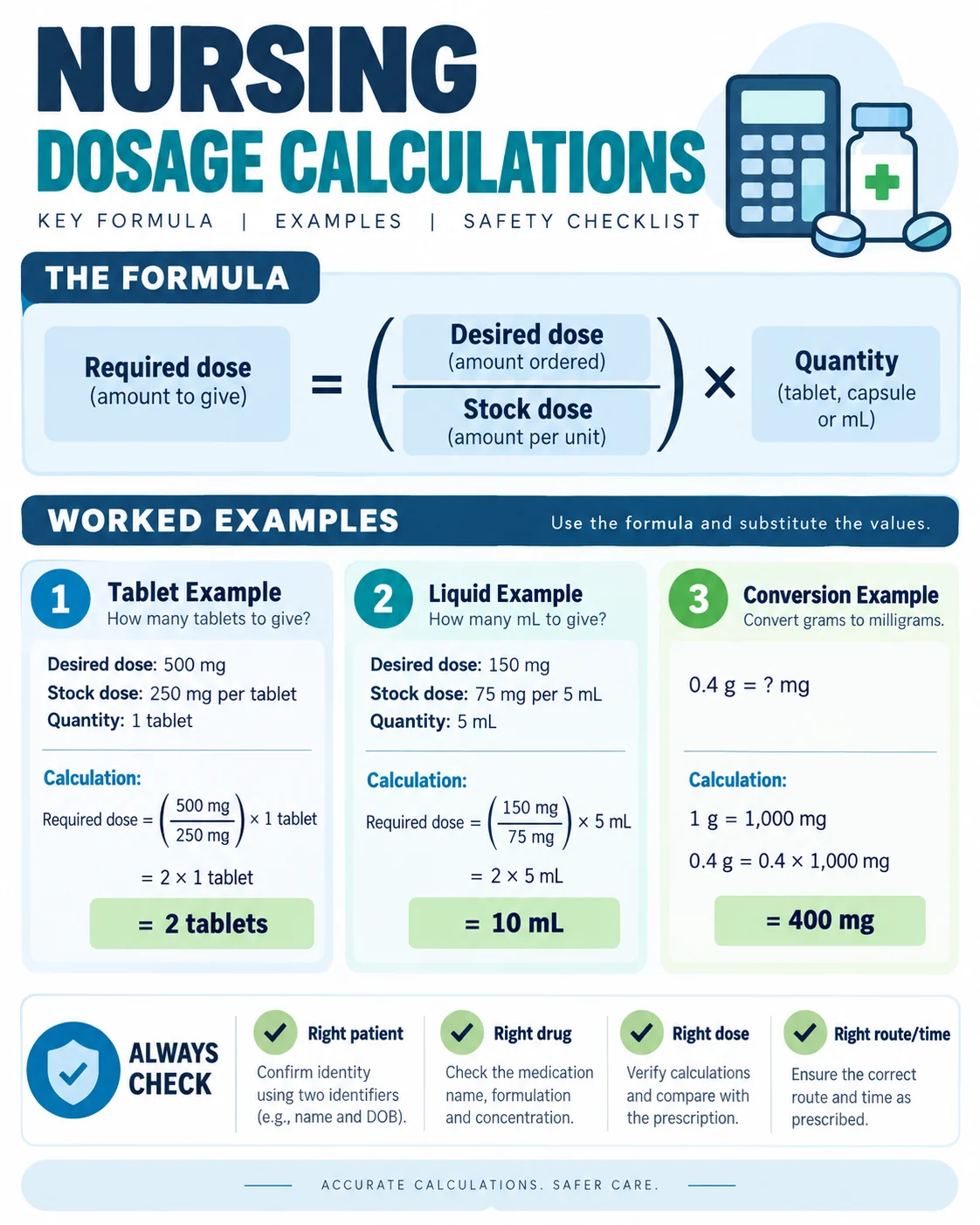
Three ways to solve nursing dosage calculations
Desired-over-have: (desired dose ÷ available dose) × available quantity = required quantity. This is one educational method, not a substitute for clinical verification.
Dimensional analysis: multiply conversion fractions so unwanted units cancel and the requested unit remains. This becomes especially valuable when units differ (for example, grams and milligrams).
Ratio and proportion: express the relationship between labelled dose and volume, then solve for the unknown volume. A complete solution should agree with dimensional analysis when the setup is correct.
Before calculating: check the units and question
- Read the hypothetical question and determine whether the answer should be tablets, mL, mg, or mL/hour.
- Check units on the fictional order and the available product strength. Convert only where needed.
- Set up the equation and cancel like units.
- Calculate without premature rounding; use local examination instructions for a final rounded response.
- Do a reasonableness check: if the required dose doubles, should the calculated number of tablets or millilitres double?
Gram, milligram and microgram conversions differ by factors of 1,000; write each unit explicitly.
Worked example 1: tablet dosage
Fictional exercise: An order requests 500 mg. The labelled tablet strength is 250 mg/tablet. How many tablets does the arithmetic yield?
Step 1: 500 mg ÷ 250 mg/tablet.
Step 2: The mg units cancel.
Result: 2 tablets.
This verifies arithmetic only. In practice, formulation, medication identity, appropriateness of the order, contraindications and product-specific instructions also matter.
Worked example 2: oral-liquid volume
Fictional exercise: An order requests 150 mg. A liquid label states 75 mg in every 5 mL.
150 mg × (5 mL ÷ 75 mg) = 10 mL.
Check: 75 mg per 5 mL means 150 mg requires twice the volume, or 10 mL. The correct measuring device and actual formulation must be checked in any real setting.
Worked example 3: convert grams to milligrams
Exercise: Convert 0.4 g into mg.
0.4 g × (1000 mg ÷ 1 g) = 400 mg.
Do not confuse mg with mcg. A milligram equals 1000 micrograms. Unit mistakes can lead to very large dosing errors.
Worked example 4: fluid rate mathematics
Fictional volume/time calculation: Calculate the arithmetic average rate for a total volume of 750 mL over six hours.
750 mL ÷ 6 h = 125 mL/hour.
This does not establish whether such an order is clinically appropriate, whether it is safe for a particular patient, or whether an infusion device may be programmed without supervision. Clinical infusion calculations require specific orders, policies, verification and competency.
Educational safety workflow. Independent checks and sign-off requirements depend on medication and local policy.
Medication calculation mistakes students should avoid
| Error | Why it matters | Check |
|---|---|---|
| Answer in the wrong unit | mg is not the same as mL or tablets | Write the desired answer unit first |
| Missing conversion | g, mg and mcg differ by factors of 1000 | Cancel units explicitly |
| Decimal point error | Can cause tenfold errors | Use a leading zero before values less than one, and avoid unnecessary trailing zeros in medication writing |
| Premature rounding | Can introduce error into multi-step arithmetic | Round at the final step as directed |
| Mathematically correct, clinically inappropriate result | Formula alone does not verify the order or product | Review the order, formulation, patient factors and institutional safety checks |
Practice calculations with answers
- Question: 600 mg required, 300 mg/tablet available. Answer: 2 tablets.
- Question: 200 mg required, 100 mg/5 mL available. Answer: 10 mL.
- Question: Convert 0.75 g to mg. Answer: 750 mg.
- Question: Arithmetic average for 600 mL over 4 hours. Answer: 150 mL/hour.
These are worked examples, not a clinical competency examination or a substitute for an independently validated practice bank. For separate interactive questions, use Practice Nursing MCQs.
How to check dosage answers for nursing exams
First identify the answer unit expected in the question, including whether a whole tablet, a decimal volume or a converted mass is requested. Check the units that cancel. If a result appears implausible, redo the setup rather than relying on memory. In clinical settings, unresolved discrepancies must be escalated to a qualified colleague or pharmacist in accordance with policy. Do not guess or administer from an unverified calculation.
Related learning
Study medication administration safety and the six rights, NMC CBT numeracy preparation, and ratios, percentages and units. Use the numeracy lesson to revise unit conversions, then return here to work through the calculation examples.
How this resource is prepared: See our editorial standards, source policy and clinical-review disclosures. References and independent clinical sign-off are not interchangeable.
References and review requirements
- OpenStax Clinical Nursing Skills — Dosing.
- OpenStax Pharmacology for Nurses — Dosage Calculations.
- NCBI Bookshelf Nursing Skills — Math Calculations.
- OpenStax Clinical Nursing Skills — Rights of Medication Administration.
Independent review pending: a qualified nursing educator or pharmacist independently verifies every worked calculation, wording on medicine and infusion safety, rounding guidance, clinical examples and the live reference links; the appropriate reviewer attribution is recorded only after actual approval.