
Fundamentals of Nursing is the foundation of professional, person centered nursing care. It teaches why nurses assess a patient, identify needs, prioritize risks, plan care, provide safe clinical interventions, communicate findings and evaluate whether care helped. These notes combine Fundamentals of Nursing I (BS Nursing Semester 1) and Fundamentals of Nursing II (Semester 2) into one searchable learning guide, with examples, tables, questions and nursing applications.
Quick answer: Fundamentals I develops professional identity, basic nursing concepts, safe care, communication and introductory nursing procedures. Fundamentals II applies these principles to patient assessment, functional health patterns, documentation, nursing care planning, vital signs, mobility and clinical skills. The HEC–PNMC revised 2024 BSN scheme lists Fundamentals I as 3 credits (2 theory, 1 skills) and Fundamentals II as 4 credits (2 theory, 1 clinical, 1 skills).
Full contents: view all 31 topics by semester
1. What is Fundamentals of Nursing? Definition, purpose and learning outcomes
What does a nursing student learn in Fundamentals of Nursing?
Nursing fundamentals brings together basic sciences, clinical reasoning, practical patient care and the professional responsibilities of nurses. It prepares students to establish trust, recognize changes from an individual’s baseline, deliver appropriate care with supervision and understand when a concern needs urgent escalation. Nursing is more than carrying out procedures: it includes assessment, advocacy, education, coordination and evaluating patient responses.
| Fundamentals I: first semester foundations | Fundamentals II: second semester applications |
|---|---|
| History, identity, concepts of professional nursing | Systematic interviewing and functional-pattern assessment |
| Health, illness, health beliefs and human needs | Prioritized nursing care plans and outcome evaluation |
| Therapeutic communication and patient participation | Accurate observations, vital signs, records and handovers |
| Ethics, consent, confidentiality and basic safety | Positioning, transfer, range of motion and comfort measures |
| Introductory hygiene, bed care and ward orientation | Applying technical and safety principles in clinical settings |
How to study this page: Read each concept, use the comparison chart to distinguish similar terms, answer the short question without looking, then review the clinical example. For any procedure, use your college or hospital’s current competency checklist and supervision. A web article cannot certify clinical competence.
START OF SEMESTER 1 NOTES
Fundamentals of Nursing I: Semester 1 · Professional foundations and introductory care
This section continues until the clearly marked Semester 2 divider.
Part I: Fundamentals of Nursing I (BSN Semester 1)
Course goal: Understand nursing as a profession, compare nursing concepts and health models, prioritize basic human needs, communicate therapeutically, and perform introductory safety and comfort skills under supervision. The curriculum also includes clinical orientation and observation of the healthcare team, admission process, legal forms, hygiene and bed making.
SEMESTER 1 · FUNDAMENTALS OF NURSING I
2. History of nursing, key contributors and nursing as a profession
How did modern nursing develop?
Caregiving has existed throughout recorded history, but professional nursing became increasingly organized through education, public health, sanitation, evidence gathering and formal standards of care. Modern nurses use scientific knowledge alongside humane, respectful relationships. History helps students understand why accurate observation, hygiene, public trust, education and professional accountability remain essential.
| Nursing figure | Contribution and learning point |
|---|---|
| Florence Nightingale | Highlighted environmental cleanliness, ventilation, observation, hospital reform and use of data to improve care. |
| Mary Seacole | Known for practical nursing and support to people affected by the Crimean War; her work illustrates care outside established institutional structures. |
| Virginia Henderson | Emphasized helping individuals meet fundamental needs and develop independence where possible. |
| Dorothea Orem | Developed self-care deficit nursing theory, drawing attention to what people can do for themselves and when nurses provide support. |
| Hildegard Peplau | Emphasized the therapeutic relationship between the nurse and patient and communication. |
| Sister Callista Roy | Developed an adaptation model viewing people as adaptive systems responding to changing circumstances. |
Profession vs occupation in nursing
An occupation is broadly any kind of paid work. A profession ordinarily has a specialized knowledge base, formal education, standards, ethical obligations, responsibility to the public and defined accountability. Nursing is a regulated profession in many countries because patient safety depends on competence and responsible judgment. Actual responsibilities depend on professional registration, local law, education and employment role.
What are nursing theories and models?
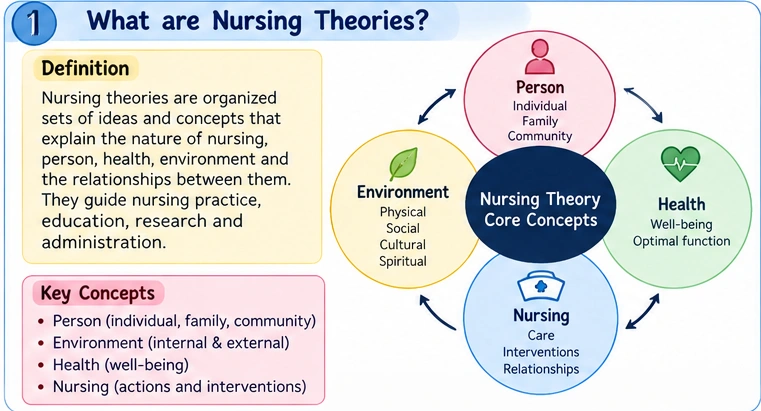
A nursing theory explains or organizes relationships among concepts such as person, environment, health and nursing care. A model is a conceptual framework that helps clinicians view a situation systematically. Nursing theories guide reasoning but do not replace a current assessment, applicable law or evidence-based protocol.
| Theoretical perspective | Core idea | Basic example |
|---|---|---|
| Henderson’s need theory | Support fundamental needs and independence | Help a patient regain safe independence in hygiene and mobility. |
| Orem’s self-care theory | Identify abilities and gaps in self-care | Teach a patient to perform aspects of care they can safely manage. |
| Peplau’s interpersonal theory | Use the relationship between the nurse and patient therapeutically | Listen and clarify concerns during a difficult admission. |
| Roy adaptation model | Understand responses and adaptation | Assess how a new mobility limitation affects daily function. |
SEMESTER 1 · FUNDAMENTALS OF NURSING I
3. Professional nursing roles, scope of practice and the healthcare team
What are the main roles and responsibilities of a professional nurse?
- Care provider: assess needs and provide safe, individualized care within authority and competence.
- Advocate: promote patient dignity, understanding, preferences and appropriate access to care.
- Educator: explain conditions, safety practices, medicines and self-care in understandable language.
- Communicator: convey important information to patients, families and the healthcare team.
- Coordinator: organize continuity of care, referrals and discharge preparation.
- Safety professional: identify hazards, maintain infection prevention and escalate deterioration.
- Reflective practitioner: review outcomes, maintain skills and use reliable evidence.
What is scope of nursing practice?
Scope of practice describes the nursing activities permitted by applicable professional regulation, educational preparation, employer policy and clinical competence. A student nurse practises under the supervision required by the training programme. Activities such as prescribing, independently diagnosing medical illness or performing invasive procedures cannot be assumed to be within every nurse’s role. In Pakistan, students should check current Pakistan Nursing and Midwifery Council requirements and institutional rules.
What is the role of other healthcare team members?
| Team member | Typical contribution |
|---|---|
| Nurse | Continual assessment, care coordination, direct nursing care, patient advocacy and communication. |
| Physician or authorized prescriber | Medical diagnosis and treatment decisions within professional authority. |
| Pharmacist | Medication review, interactions, supply, drug safety and education. |
| Physiotherapist | Functional mobility assessment and rehabilitation interventions. |
| Dietitian | Nutritional assessment and individualized nutrition recommendations. |
| Laboratory professional | Specimen processing and diagnostic laboratory testing. |
| Social worker / discharge coordinator | Practical, social and community support relevant to discharge planning. |
Ward orientation: Identify patient areas, nursing station, clean/soiled utility zones, hand-hygiene points, emergency equipment, medication storage, sharps and waste disposal, exits, equipment-cleaning processes, escalation contacts and documentation systems. Check where consent and admission forms are handled. The purpose is to learn how a safe ward functions before independently carrying out tasks.
SEMESTER 1 · FUNDAMENTALS OF NURSING I
4. Health, wellness, illness, disease and patient centered care
What is the difference between health, wellness, illness and disease?
| Term | Meaning | Nursing example |
|---|---|---|
| Health | A multidimensional condition involving physical, mental and social functioning, not merely the absence of a diagnosed disease. | Assess functioning, goals and wellbeing. |
| Wellness | An active process of supporting wellbeing through habits and conditions. | Discuss achievable activity and sleep goals. |
| Illness | An individual’s experience of feeling unwell or having impaired function. | A patient reports fatigue even when investigations are ongoing. |
| Disease | An identifiable pathological condition or disorder, which may or may not be symptomatic. | Hypertension can be present without noticeable symptoms. |
| Health promotion | Helping people improve control over factors that affect health. | Counsel on activity, nutrition and preventive care. |
| Disease prevention | Actions reducing disease occurrence or consequences. | Vaccination, screening and complication prevention as applicable. |
Health belief model: why do patients behave differently?
The Health Belief Model helps explain health decisions through perceived susceptibility, perceived severity, perceived benefits of action, perceived barriers, prompts to act and confidence in performing the action. A patient may understand the importance of mobility but fear falling, so education alone may not change behaviour. Explore the person’s beliefs, practical barriers, cultural needs and readiness rather than assuming noncompliance.
Biopsychosocial and spiritual care
Holistic nursing considers physical symptoms, emotional distress, personal relationships, financial resources, cultural preferences, spiritual beliefs and social circumstances that may influence care. Ask what matters to the patient; do not assume needs from age, background or religion. Respectfully document relevant preferences and use qualified interpreters when necessary.
SEMESTER 1 · FUNDAMENTALS OF NURSING I
5. Maslow’s hierarchy of needs in nursing and patient prioritization

What is Maslow’s hierarchy of needs?
Maslow’s hierarchy is a conceptual framework organizing needs commonly described as physiological needs, safety, belonging, esteem and self-actualization. In nursing it can be a memory aid for understanding patient priorities, but it is not an inflexible rule and must not override immediate clinical danger, patient preferences or judgment.
| Level | Meaning | Nursing example |
|---|---|---|
| Physiological | Breathing, hydration, nutrition, elimination, rest and temperature regulation | Recognize severe breathing difficulty and escalate urgently. |
| Safety | Protection from immediate harm and avoidable risks | Assess fall risk and prevent unsafe movement. |
| Belonging | Connection, support and trusted relationships | Facilitate communication with supporters within policy. |
| Esteem | Dignity, autonomy and confidence | Invite the patient to participate in feasible self-care. |
| Self-actualization | Purpose, learning and personal development | Support long-term goals after stabilization. |
How do nurses prioritize patients using Maslow and ABC?
Consider airway, breathing and circulation (ABC), urgent changes from baseline and immediate safety threats first. Maslow can then help organize other unmet needs, but the actual sequence depends on assessment. For example, a person with acute respiratory distress requires immediate action and escalation before a routine education session. A patient with stable breathing but a high fall risk may need assistance before walking. Professional prioritization integrates urgency, clinical risk and the individual’s values.
Exam contrast: Maslow describes categories of human need; ABC is an urgent physiological-priority heuristic. Neither replaces checking the patient, following emergency procedures or engaging the clinical team.
SEMESTER 1 · FUNDAMENTALS OF NURSING I
6. Nursing ethics, consent, confidentiality, cultural safety and professional behaviour
| Principle | Meaning in nursing practice |
|---|---|
| Autonomy | Support informed and voluntary decisions within applicable law. |
| Beneficence | Aim to provide benefit for the patient. |
| Nonmaleficence | Avoid preventable harm. |
| Justice | Treat people fairly and support equitable access. |
| Veracity | Communicate accurately and do not intentionally mislead. |
| Fidelity | Honour professional responsibilities and commitments. |
| Confidentiality | Protect patient information and use it only for authorized purposes. |
What is informed consent and how does it relate to nursing?
Valid informed consent generally requires relevant information, adequate decision-making capacity, voluntary choice and the opportunity to ask questions; requirements vary by jurisdiction, procedure and circumstances. Nurses support understanding and document what they are responsible for, while the professional performing or ordering a procedure may have specific legal obligations. Consent is an ongoing communication process rather than merely obtaining a signature.
How should nurses handle a disagreement with a patient’s values?
Explore the patient’s perspective without judgement, check what options are clinically reasonable, clarify any safety implications, involve appropriate team members and follow law and institutional policy. Respect for beliefs does not mean ignoring urgent threats or bypassing required consent. Involving qualified interpreters or designated cultural support can improve shared decision-making.
Confidentiality and social media: what should a student remember?
Do not discuss identifiable patient information with unauthorized persons or post patient images, observations or documentation on social media. Use approved clinical systems, secure records and minimum-necessary sharing. Even a story without a name may identify someone through contextual details.
SEMESTER 1 · FUNDAMENTALS OF NURSING I
7. Therapeutic communication techniques in nursing with examples
Therapeutic communication is purposeful, patient centered interaction that supports trust, understanding, coping and informed participation. It includes attentive verbal and nonverbal behaviour. A nurse’s tone, pacing, listening, appropriate silence and awareness of cultural needs matter as much as the chosen words.
| Technique | Helpful example | Why it works |
|---|---|---|
| Open-ended question | “What concerns you most about going home?” | Invites the patient to explain priorities in their own words. |
| Active listening | Give full attention, avoid interruption and acknowledge key points. | Shows respect and may reveal information relevant to assessment. |
| Reflection | “You seem worried about the procedure.” | Names a possible feeling and invites confirmation or correction. |
| Clarification | “When you say dizzy, do you mean the room spins or you feel faint?” | Distinguishes descriptions that may have different implications. |
| Restatement | “So the pain began after you stood up?” | Checks that the nurse heard the sequence correctly. |
| Summarizing | “We’ve discussed your discomfort, support at home and medicines.” | Confirms shared understanding and supports handoff. |
| Teach-back | “So I know I explained it clearly, how will you take the medicine?” | Checks communication effectiveness without blaming the patient. |
| Therapeutic silence | Allow quiet space after a difficult disclosure. | Provides time to think and respond. |
What is nontherapeutic communication?
Statements such as “Don’t worry, nothing bad will happen,” unnecessary jargon, judgmental questions or changing the subject may invalidate concerns or provide false reassurance. Replace them with honest, empathetic explanations. Instead of “Why didn’t you follow the instructions?” ask “What made the plan difficult to follow?”
How can nurses communicate with someone who has limited English or hearing difficulty?
Identify the patient’s preferred language and communication method. Use professional interpretation and relevant communication aids; speak directly to the patient, check understanding and maintain privacy. A family member should not automatically substitute for a qualified interpreter in important consent or complex clinical conversations.
Therapeutic communication versus everyday conversation
Everyday conversation can be informal and reciprocal. Therapeutic communication has a patient-focused purpose, boundaries, attention to accuracy and privacy, and may use assessment-oriented questions. Being friendly is helpful but does not replace clinical reasoning.
SEMESTER 1 · FUNDAMENTALS OF NURSING I
8. Fundamental nursing safety: infection control, patient identification and risk reduction
Patient safety means reducing avoidable harm from care. Important introductory habits include identifying the correct patient before actions, maintaining hand hygiene, reporting changes from baseline, using appropriate equipment and supervision, checking environmental hazards and communicating promptly about concerns.
- Two appropriate identifiers: use the institution’s policy and verify identity before medicines, specimens or procedures; a room number alone is not a reliable identifier.
- Standard Precautions: apply to all patient care. Hand hygiene and PPE chosen according to the risk accompany safe injection and equipment/environmental hygiene.
- Falls: evaluate mobility, symptoms, medicines, footwear, environment and need for assistance. Avoid relying solely on a risk score.
- Pressure injury prevention: assess skin and risk; protect pressure points, support mobility and use appropriate surfaces.
- Sharps and equipment: follow approved handling and disposal procedures.
- Speaking up: stop an unsafe task, seek help and use the escalation pathway when concern arises.
For relevant skills, see WHO Five Moments of Hand Hygiene and Microbiology for Nursing Students. These links supplement rather than replace the explanations provided here.
SEMESTER 1 · FUNDAMENTALS OF NURSING I
9. Patient admission, ward orientation, transfers and discharge
What does a nurse assess when a patient is admitted?
According to the clinical setting and the student’s supervised role, establish identity and immediate safety, understand the reason for admission, gather relevant history, current medicines and allergies, measure baseline observations, identify mobility and communication needs, assess pain and other current symptoms, review pertinent referrals and explain the care environment. Give the patient an opportunity to ask questions.
Admission, transfer and discharge: how are they different?
| Process | Purpose | Essential nursing concerns |
|---|---|---|
| Admission | Bring the patient into the appropriate care setting | Identity, initial assessment, consent, orientation, baseline safety and accurate records |
| Transfer | Move the patient or responsibility to another unit/team | Clinical stability, required assistance, equipment, a complete handoff and acknowledgment of responsibility |
| Discharge | Plan for a safe transition out of the care setting | Instructions, medicines, follow-up, warning signs, support, understanding and documentation |
What should be documented during patient transfer?
Capture the patient’s condition, current concerns, relevant assessment and observations, important devices, allergies, care already given, pending tasks, the receiving team and the handoff time, according to local policy. Transfer of accountability requires clear communication and confirmation, not simply sending paperwork.
SEMESTER 1 · FUNDAMENTALS OF NURSING I
10. Patient hygiene, comfort, occupied and unoccupied bed making
Why is hygiene an important nursing responsibility?
Personal care promotes comfort, supports skin assessment, reduces avoidable contamination and can preserve dignity and independence. Ask about preferences and what the patient can do safely, provide privacy, explain each action and avoid exposing the person unnecessarily. Assess skin condition during care and document concerning findings.
What is an occupied bed and an unoccupied bed?
| Bed type | Definition | Safety priority |
|---|---|---|
| Occupied bed | Linen and bed environment are adjusted while the patient remains in bed. | Work with appropriate assistance, maintain privacy, prevent unsafe rolling and protect lines/devices. |
| Unoccupied bed | Bed is prepared when the patient is not in it. | Clean environment, linen handling, safe bed height and readiness for the next patient. |
| Postoperative or special setup | Bed setup adapted for a specified clinical need. | Follow the institution’s instructions rather than a universal design. |
How is a bed bath planned for a dependent adult?
Assess the patient’s condition, hygiene preferences, pain, temperature tolerance, ability to participate, skin integrity, infection control needs and available assistance. Explain care, maintain dignity, arrange suitable clean equipment, use facility-approved methods, reduce friction and exposure, and leave the patient comfortable with call assistance accessible. The exact washing and linen sequence should follow the local training checklist; it is not safe to infer one method for every patient.
Comfort measures in basic nursing care
Comfort is physical and psychological. It may involve suitable positioning and support, helping with sleep, minimizing unnecessary noise, addressing pain, providing mouth care and offering reassurance without false promises. Document both the patient’s expressed goal and their response to the intervention.
START OF SEMESTER 2 NOTES
Fundamentals of Nursing II: Semester 2 · Assessment, the nursing process and applied clinical skills
Everything below, until exam practice, belongs to Semester 2.
Part II: Fundamentals of Nursing II (BSN Semester 2)
Course goal: Apply critical thinking and the nursing process during patient assessment and clinical care. The revised HEC–PNMC 2024 course emphasizes functional health patterns, based on patient interviews data collection, documented vital signs, safe positioning and transfers, range of motion exercises, body alignment and accurate written records. Nursing Fundamentals II has 4 credits, including theory and practical/clinical learning.
SEMESTER 2 · FUNDAMENTALS OF NURSING II
11. Gordon’s 11 functional health patterns: nursing assessment with examples

What are Gordon’s 11 functional health patterns?
Gordon’s functional health patterns are an organized framework for gathering a broad picture of a person’s usual functioning and current needs. They prevent assessment from focusing exclusively on the chief symptom. The patterns span health behaviours, nutrition, elimination, activity, rest, cognition, self-concept, relationships, sexuality, coping and personal values. They guide information gathering; they are not themselves medical diagnoses.
| Health pattern | Assessment focus | Example question |
|---|---|---|
| 1. Health perception–health management | Understanding of health, prevention habits, medicines and care access | “How do you usually manage your health or medicines?” |
| 2. Nutritional–metabolic | Food/fluid intake, weight trends, skin condition and metabolic needs | “Have you had any change in appetite, drinking or weight?” |
| 3. Elimination | Urinary and bowel patterns, changes, continence | “What changes have you noticed in urination or bowel habits?” |
| 4. Activity–exercise | Mobility, exercise tolerance, breathing during activity and daily living | “Which activities can you perform safely without assistance?” |
| 5. Sleep–rest | Sleep patterns, restfulness, interruptions | “How many hours do you usually sleep, and do you feel rested?” |
| 6. Cognitive–perceptual | Orientation, memory, communication, senses and pain | “Have you noticed changes in memory, hearing, vision or pain?” |
| 7. Self-perception–self-concept | Body image, confidence, self-esteem and emotional perception | “How has this illness changed how you see yourself?” |
| 8. Role–relationship | Family/support roles, relationships and social support | “Who helps you at home when you need assistance?” |
| 9. Sexuality–reproductive | Reproductive concerns, intimacy or sexual health as relevant | “Are there any private concerns about relationships or sexual health you would like to discuss?” |
| 10. Coping–stress tolerance | Responses to stress, coping strategies and available help | “What normally helps you when you feel stressed?” |
| 11. Value–belief | Personal values, cultural and spiritual preferences influencing care | “Are there beliefs or practices we should consider in your care?” |
How do you assess a patient using Gordon’s patterns?
- Begin with consent, privacy, the patient’s preferred language and immediate clinical needs.
- Use open-ended prompts and then clarify concerning or incomplete answers.
- Gather both patient-reported information and relevant observations or records.
- Identify strengths as well as limitations, including available family and community support.
- Group findings to recognize priorities, safety risks and potentially unmet needs.
- Communicate urgent concerns immediately; document and reassess other findings as the care plan develops.
Worked example: An adult patient recovering from surgery reports poor sleep, reduced appetite, fear of falling and limited mobility. Sleep–rest, nutritional–metabolic, coping–stress and activity–exercise patterns all deserve attention. However, if the patient suddenly becomes breathless, assessing immediate respiratory status takes priority over completing all pattern questions. The framework structures care; it does not delay urgent action.
SEMESTER 2 · FUNDAMENTALS OF NURSING II
12. Nursing assessment: subjective vs objective data, primary and secondary sources
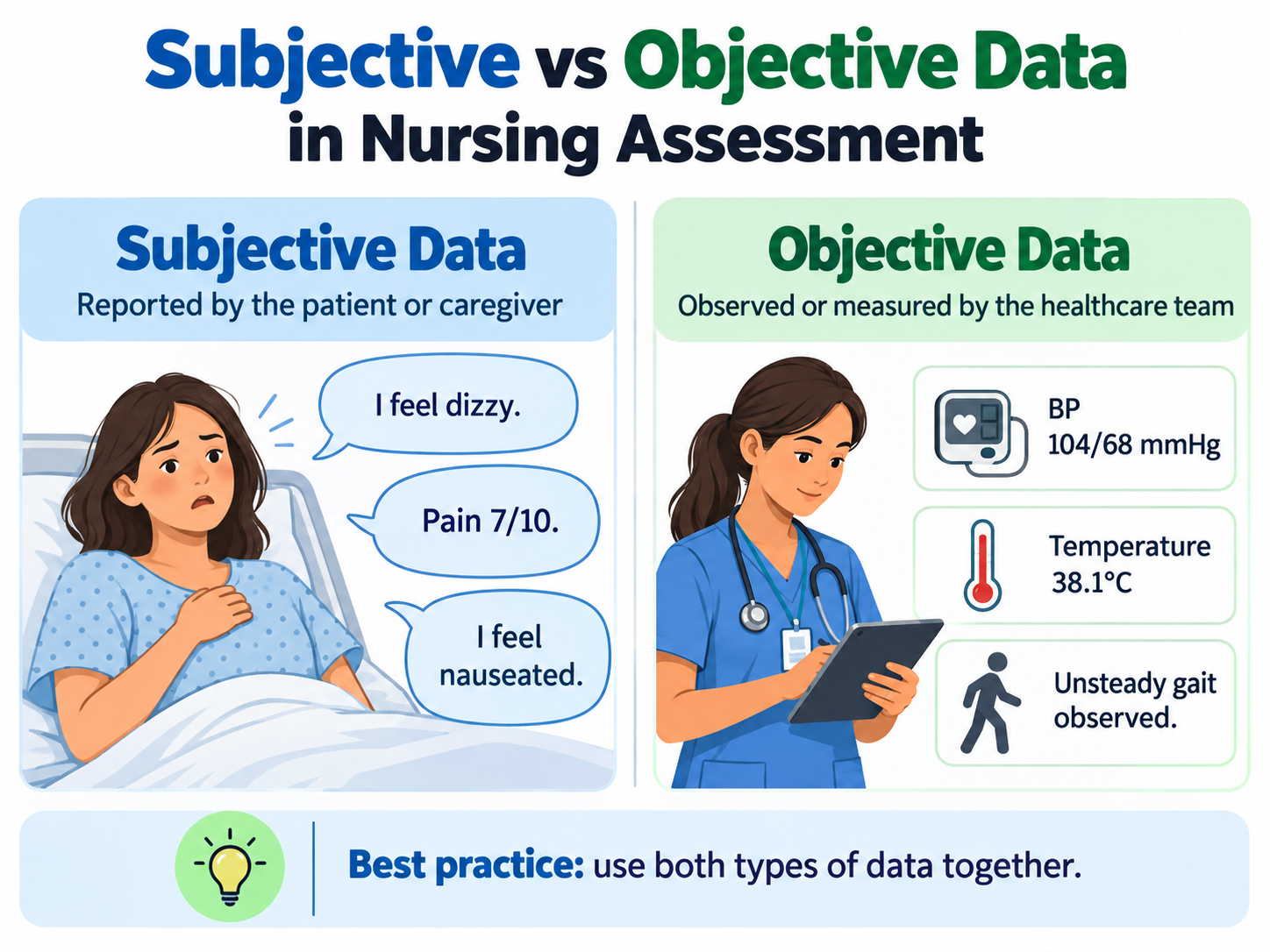
What is subjective data in nursing?
Subjective data are symptoms, perceptions or experiences reported by the patient or another informant, such as “I feel dizzy,” “My pain is 7 out of 10,” or “I haven’t slept properly.” A patient’s description of pain is subjective even when expressed numerically. Record the actual statement when its wording matters.
What is objective data in nursing?
Objective data are observable or measurable findings such as measured blood pressure, documented pulse, visible swelling, observed gait, laboratory results or a nurse’s observation of breathing effort. Objective does not mean more important than subjective; both can reveal clinically relevant changes.
| Finding | Subjective or objective? | Reason |
|---|---|---|
| “I am nauseated.” | Subjective | The patient describes an internal symptom. |
| Blood pressure 104/68 mmHg | Objective | A recorded measurement, whose meaning depends on context. |
| “My knee hurts when I move it.” | Subjective | Self-reported pain. |
| Patient walks with noticeable unsteadiness | Objective | A directly observed movement pattern. |
| “I usually drink two glasses of water a day.” | Subjective | History provided by the patient. |
| Fluid intake of 450 mL recorded during the shift | Objective/documented | Measured or charted quantity, dependent on record accuracy. |
| Patient reports feeling cold | Subjective | A personal sensation. |
| Temperature 38.1 °C via specified route | Objective | Instrument measurement with known method. |
What are primary and secondary sources of nursing data?
A primary source is generally the patient, who can describe experiences, preferences and history. Secondary sources may include caregivers, other clinicians, prior records and test findings, depending on consent and relevance. A substitute source is not automatically reliable: clarify inconsistencies and avoid assuming that someone else’s description replaces the patient’s own view.
What is the difference between signs and symptoms?
A symptom is experienced or reported, such as nausea or dizziness. A sign is an observable or measurable indication, such as a rash or elevated measured temperature. Some findings involve both: a patient may describe difficulty breathing while the nurse also observes rapid, laboured respiration.
What is a baseline and why do nursing assessments use it?
A baseline is an initial or usual reference for the person’s condition. Changes in observations, mental status, pain or mobility can be more informative than one number in isolation. A patient may have a reading within a broad population range but still show a clinically important change from their usual status.
SEMESTER 2 · FUNDAMENTALS OF NURSING II
13. ADPIE nursing process and the six components (ADOPIE) explained
What is the nursing process?
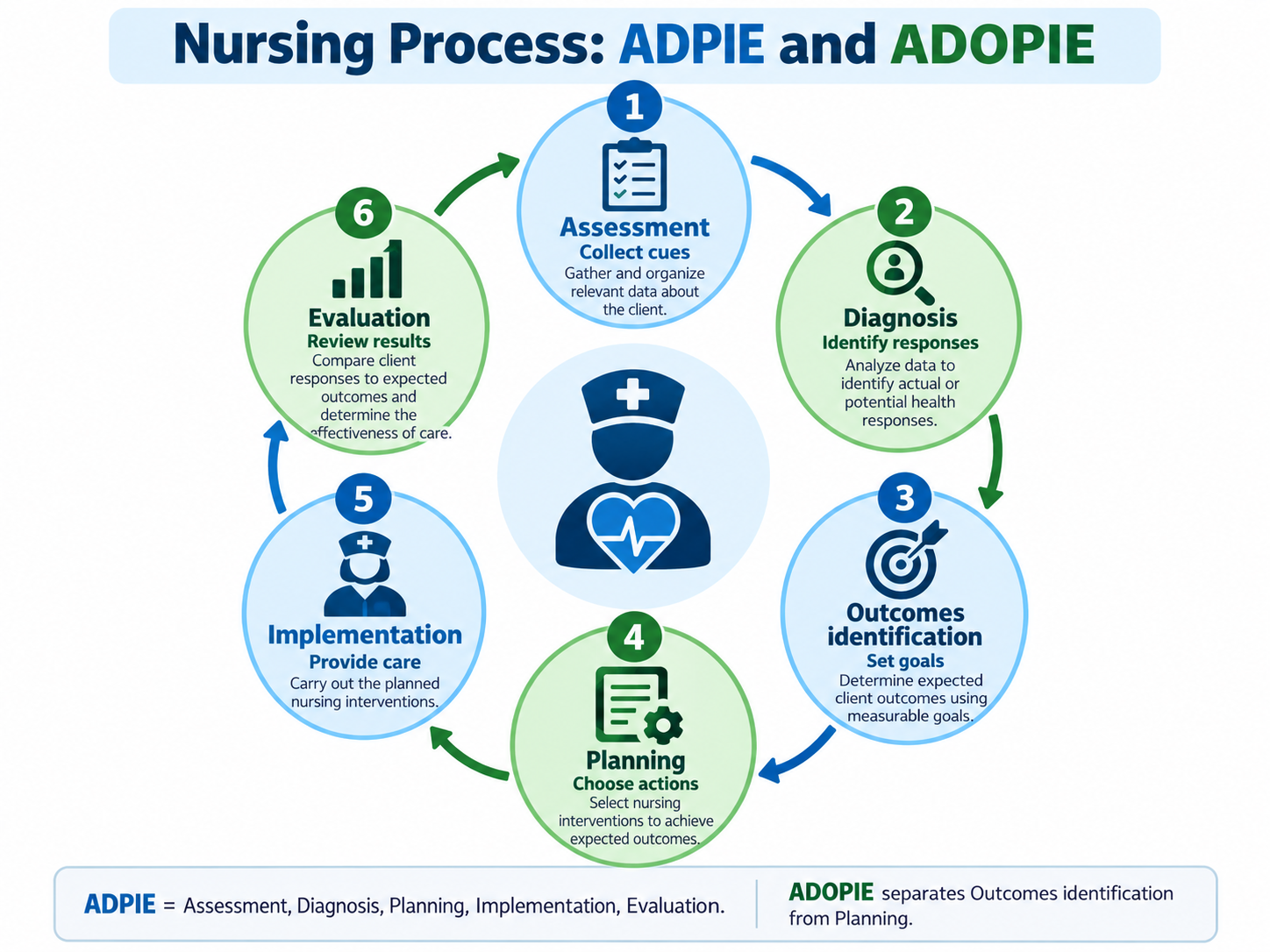
The nursing process is a systematic, cyclical method used to assess needs, identify nursing problems or responses, set outcomes, plan and provide interventions, and evaluate results. It helps organize evidence-based, individualized nursing care rather than making care a checklist of disconnected tasks.
What does ADPIE stand for?
ADPIE is a common five-part memory aid: Assessment, Diagnosis, Planning, Implementation, Evaluation. In many curricula the planning phase includes identifying desired outcomes. Current ANA Scope and Standards distinguish outcomes identification as its own component, yielding the six-part mnemonic ADOPIE: Assessment, Diagnosis, Outcomes Identification, Planning, Implementation, Evaluation. The HEC Fundamentals II clinical outcomes also refer to six components. Students should understand both terms and their relationship rather than treating one as an error.
| Component | The nurse asks | Example for dizziness on standing |
|---|---|---|
| A: Assessment | What are the patient’s symptoms, observations, baseline and risks? | Patient says “I feel faint”; observe unsteadiness and assess relevant vital signs. |
| D: Diagnosis / problem identification | What human response or nursing problem is supported by the data? | Recognize an immediate safety risk and further assessment needs. |
| O: Outcomes identification | What specific, measurable change do we want and by when? | Patient will transfer safely with the agreed assistance during the shift. |
| P: Planning | What individualized actions will support the outcome? | Arrange assistance, reassessment and an appropriate safe mobility plan. |
| I: Implementation | What does the approved plan require us to do now? | Pause unsafe transfer, assist patient safely and escalate concerning findings. |
| E: Evaluation | Did the patient achieve the outcome, and what changed? | Check whether transfer was safely completed or the plan needs revision. |
Why is the nursing process called cyclical?
Evaluation informs new assessments. If an intervention is ineffective, if the patient reports new symptoms or if observations change, the nurse reassesses priorities and revises the care plan. Documentation records the reasoning and response so the next caregiver can continue appropriate care. It is not a one-time sequence performed only on admission.
What is the difference between critical thinking and clinical judgment?
Critical thinking is the broader ability to analyze information, question assumptions and consider evidence. Clinical judgment applies that reasoning to the actual patient and situation, leading to care decisions within scope. A student can know a normal pulse range but still needs clinical judgment to determine whether a change in the patient’s symptoms requires immediate escalation.
Clinical judgment and NCLEX-style reasoning
A practical sequence is: recognize relevant cues → analyze what they may mean → prioritize hypotheses or concerns → select safe actions → act within the role and setting → evaluate outcomes. This reasoning complements the nursing process and is useful for based on patient cases examinations, though examination frameworks and local competencies may use different labels.
SEMESTER 2 · FUNDAMENTALS OF NURSING II
14. Nursing diagnosis vs medical diagnosis: differences and worked examples
What is a nursing diagnosis?
A nursing diagnosis is a clinical judgment concerning a person’s responses to actual or potential health conditions or life processes. It guides nursing interventions. A medical diagnosis identifies an illness or pathological condition assessed by an appropriately authorized clinician. Nurses collaborate in medical care, but the two types of diagnosis answer different questions.
| Medical diagnosis | Possible nursing problem or response | Nursing assessment emphasis |
|---|---|---|
| Pneumonia | Impaired ability to manage secretions, activity intolerance or relevant breathing concerns | Respiratory effort, oxygenation, symptoms and tolerance of care |
| Hip fracture | Reduced mobility, pain and risk of falling | Movement, assistance needs and safety |
| Heart failure | Fluid balance concerns, decreased activity tolerance or breathing difficulty | Fluid trends, weight, symptoms, baseline changes |
| Diabetes mellitus | Health-management needs, risk of skin complications or knowledge gaps | Self-care capabilities, foot/skin checks and education needs |
Important: The phrases in the right-hand columns are illustrative responses and may not be exact standardized diagnostic labels. Do not present a nursing problem as a confirmed patient diagnosis unless it is supported by appropriate assessment and required terminology. Our care-plan teaching should not imply that a generic example is a prescription.
Actual, risk and health-promotion nursing diagnoses
An actual/problem-focused diagnosis describes an identified human response with supporting defining characteristics. A risk diagnosis describes vulnerability to a possible problem, so the problem itself has not occurred. A health-promotion diagnosis recognizes motivation or readiness to improve wellbeing. Specific standardized labels and definitions depend on the approved classification version used by the school or hospital.
What is the difference between nursing diagnosis and a nursing care plan?
A nursing diagnosis/problem statement names and explains the nursing concern. A care plan integrates assessment evidence, priorities, expected outcomes, nursing interventions, rationales and evaluation. A diagnosis is one part of the plan, not the entire document.
SEMESTER 2 · FUNDAMENTALS OF NURSING II
15. SMART goals, nursing interventions, rationales and evaluation
What does SMART stand for in nursing goals?
SMART commonly means Specific, Measurable, Achievable, Relevant, and Time-bound. Some teaching contexts expand or phrase the letters differently. For clinical care, a goal should describe an outcome meaningful to the patient and feasible within the relevant time and circumstances. A task for a nurse is not necessarily a patient outcome.
| Weak statement | Improved nursing outcome | Why it is stronger |
|---|---|---|
| Patient will improve. | Patient will describe two agreed safety measures before discharge. | Defines a specific observable outcome and timeframe. |
| Nurse will check pain. | Patient will report whether comfort has improved after the agreed reassessment interval. | Measures response rather than a task alone. |
| Patient will walk better. | Patient will perform the agreed transfer with the documented level of assistance by the end of the shift, if clinically stable. | Links function, safety and timing. |
| Will be healthy soon. | Patient will identify whom to contact for worsening symptoms before leaving the unit. | Feasible and patient centered. |
What is the difference between an intervention and its rationale?
An intervention is an action performed to address a patient need, such as assisting with a transfer after assessment. A rationale explains why that action is expected to help. For example,, appropriate assistance reduces the risk of a fall during mobility. A sound rationale relates to the specific patient and current evidence, not merely “because the doctor said so.”
Worked mini care plan: Adult patient at risk of falling
| Care-plan element | Sample learning response |
|---|---|
| Assessment | Patient reports dizziness when standing; unsteady movement observed during preparation for transfer. |
| Priority problem | Immediate risk of injury during movement; investigate causes through the responsible team. |
| Outcome | The patient will complete necessary transfers without a fall using the assessed level of assistance during the shift. |
| Interventions | Stop the unsafe transfer; keep patient safe, reassess and report concerning symptoms, follow the approved mobility plan and arrange appropriate assistance. |
| Rationale | Reduces exposure to an identified hazard while assessment and care coordination occur. |
| Evaluation | Document whether transfer was safe, whether symptoms persisted and whether the plan needs updating. |
For extended care-plan formats, see Nursing Care Plans: Formats and Worked Examples. The core planning method is fully explained above, so the link is optional.
SEMESTER 2 · FUNDAMENTALS OF NURSING II
16. Vital signs nursing: normal adult reference points, assessment and escalation
What are the vital signs?
Vital signs commonly include temperature, pulse or heart rate, respiratory rate, blood pressure and oxygen saturation; pain and level of consciousness are also assessed according to context. Numbers are not substitutes for observing breathing effort, skin colour, mental status, symptoms or trends. The correct measurement technique, device and conditions matter.
| Measure | Typical resting adult reference context | Nursing interpretation |
|---|---|---|
| Temperature | Often around 36.1–37.2 °C orally; measurement route changes interpretation | Check route, baseline, symptoms and trends; fever thresholds depend on setting. |
| Pulse | Common teaching range approximately 60–100 beats/min at rest | Assess rhythm, strength, symptoms and baseline, not just rate. |
| Respiratory rate | Common resting adult range approximately 12–20 breaths/min | Observe depth, effort, distress, pattern and trends. |
| Blood pressure | No single normal for every person; 120/80 mmHg is a familiar reference point | Assess symptoms, individual baseline, cuff/technique and clinical context. |
| SpO₂ | Often approximately 95–100% in healthy adults at sea level | Interpret with clinical condition, altitude, device limitations and any prescribed target. |
| Pain | No universally ‘normal’ numerical score; patient-reported | Ask what it feels like, what matters functionally and whether measures help. |
Safety: These ranges are educational examples, not universal escalation thresholds or prescribed treatment targets. Children, pregnant patients and adults with particular conditions require different reference considerations. An adult with a low SpO₂, unusual breathlessness, altered consciousness or severe new symptoms needs timely assessment and escalation according to local policy, even if another measurement seems normal.
How to measure and document vital signs accurately
- Confirm patient identity, explain the measurement and check recent activity, symptoms, positioning or other relevant influences.
- Choose a validated device and suitable measurement site or cuff size according to policy.
- Record the actual values with units and relevant method or route, including time.
- Compare with recent readings, baseline and the patient’s observed condition.
- Repeat or verify unexpected results appropriately, without delaying urgent escalation.
- Communicate concerning changes and document who was notified and the response.
What is orthostatic hypotension and why does it matter to transfers?
Orthostatic hypotension is a drop in blood pressure associated with standing and may contribute to dizziness or falls. Formal assessment uses an institution-approved protocol, timing and safety precautions. Do not have a symptomatic patient stand alone just to collect a measurement. A transfer should be stopped if unsafe, the patient supported appropriately and relevant symptoms escalated.
See our specialized Vital Signs Assessment and Escalation guide for additional procedure-specific detail.
SEMESTER 2 · FUNDAMENTALS OF NURSING II
17. Pain assessment in nursing: numeric scales, PQRST and reassessment
How do nurses assess pain?
Pain is a personal experience and is best assessed through the patient’s report whenever they can communicate. Ask about onset, location, quality, severity, pattern, aggravating or relieving factors, effect on activities and previous responses to care. Also observe behaviour and functional impact, especially if communication is impaired. No single pain scale fully captures every person’s experience.
What does PQRST stand for in pain assessment?
| Letter | Question to ask | Example |
|---|---|---|
| P: Provocation/Palliation | What brings the pain on? What helps or worsens it? | “Does moving make it worse?” |
| Q: Quality | What does the pain feel like? | “Is it sharp, aching, burning or pressure-like?” |
| R: Region/Radiation | Where is the pain and does it spread? | “Can you show me where it goes?” |
| S: Severity | How intense is it, and how does it affect function? | “On a 0–10 scale, how severe is it?” |
| T: Timing | When did it start; constant or intermittent? | “Was the onset sudden or gradual?” |
Numeric pain scale vs Wong–Baker FACES vs behavioural assessment
A 0–10 numeric rating scale can support communication with adults who can use numerical ratings. A faces scale may help some patients, depending on its validated use and their communication needs; it should not be treated as a simple measure of visible facial expression. When a patient cannot self-report, use an appropriate validated observational tool and clinical assessment. The patient’s reported pain should not be dismissed because outward behaviour appears calm.
Why is reassessment essential after a nursing pain intervention?
Reassessment checks whether comfort and function have changed, whether adverse effects appear and whether further assessment or escalation is needed. The timing depends on the intervention, patient situation and clinical policy. Chart the initial assessment, intervention, follow-up response and communication, rather than merely that a medicine was administered.
SEMESTER 2 · FUNDAMENTALS OF NURSING II
18. Patient positioning in nursing: Fowler’s, Sims’, lateral, supine and prone

What is patient positioning and why does it matter?
Patient positioning means placing or assisting a person into an appropriate alignment to support breathing, comfort, clinical procedures, tissue protection, mobility or treatment. Safe positioning considers the patient’s condition, symptoms, skin, joints, medical devices and ability to move independently. A position is not automatically appropriate merely because it is commonly used for a symptom.
| Position | How it looks | Common educational purpose | Important nursing caution |
|---|---|---|---|
| Supine | Lying on the back | General resting, assessment or examination when suitable | Monitor pressure areas and respiratory comfort; consider contraindications. |
| Prone | Lying on the abdomen | Used in selected procedures or highly supervised respiratory-care plans | Not appropriate for everyone; can create airway, device and pressure risks. |
| Lateral / lying on the side | Lying on the side with support as indicated | Comfort, pressure redistribution and specific examinations | Support alignment and assess dependent pressure points. |
| Sims’ position | Semiprone, usually lying on the side with upper leg flexed and supported | Commonly taught for certain rectal procedures and enemas | Protect shoulders, hip, knee and other pressure points; preserve dignity. |
| Semi-Fowler’s | Head of bed raised approximately 30–45° | May support breathing and comfort | Elevation and pressure risks depend on patient condition. |
| Fowler’s | Head of bed elevated approximately 45–90° | May improve respiratory comfort and support eating when appropriate | Monitor sliding, sacral pressure and individual contraindications. |
| High Fowler’s | Upright near 90° | May be useful for selected breathing or care needs | Use stability supports and assess fatigue and comfort. |
| Trendelenburg | Whole body tilted with head lower than feet | Certain controlled clinical/procedural situations | Not routine treatment for shock or dizziness; requires indication and supervision. |
Fowler’s vs Semi-Fowler’s vs High Fowler’s position
The key distinction is the degree of elevation of the head of the bed. Semi-Fowler’s is commonly approximately 30–45°, Fowler’s approximately 45–90°, and High Fowler’s close to upright. These values are teaching conventions; specific protocols may differ. More elevation is not always better, because sliding and concentrated pressure can increase in some positions.
What is the difference between Sims’ and lateral position?
The general lateral position places the person on their side. Sims’ position is more semiprone with the upper leg flexed, and is frequently associated with particular procedures. Maintaining alignment, supporting limbs and preserving privacy matter in both. Terms may vary slightly between textbooks and institutions, so use the position required by your local skill checklist.
Which patient position is best for breathing difficulty?
Many alert adults with breathing discomfort may find an upright, supported position more comfortable, but a patient experiencing acute respiratory distress needs prompt clinical assessment, not just repositioning. Position choice depends on airway protection, haemodynamic state, injury, postoperative restrictions and prescribed care. Escalate rapidly when breathing difficulty is new or severe.
Patient positioning diagram: a simple text revision aid
| Back / stomach | Side | Head-of-bed elevation |
|---|---|---|
| Supine = back up; Prone = abdomen down | Lateral = side; Sims’ = semiprone with flexed upper leg | Semi-Fowler’s ≈30–45°; Fowler’s ≈45–90°; High Fowler’s ≈90° |
Study tip: Draw six simple patient silhouettes and label head, trunk, limb support and bed angle. The objective is to understand the body’s orientation, not to memorize a drawing without understanding pressure points or indications.
SEMESTER 2 · FUNDAMENTALS OF NURSING II
19. Body mechanics, mobility, range of motion exercises and safe transfers

What is body mechanics in nursing?
Body mechanics means how people use posture, balance, joints and muscle forces during movement. In nursing practice, movement safety is an ergonomic and system-level responsibility, not just the instruction to “bend your knees.” Assess patient capability, the environment, staff support and whether mechanical transfer aids are needed before moving anyone. Manual lifting of a dependent patient without appropriate equipment can injure both the patient and staff.
Safe transfer: bed to chair, stretcher or another bed
- Assess before moving: review patient stability, dizziness, pain, cognition, weight-bearing permissions, lines and attached equipment.
- Plan: identify required staff, mobility aids, safe destination, available space and an agreed communication signal.
- Explain and obtain cooperation: tell the patient what will happen and seek their participation within capability.
- Use approved equipment: follow the facility’s manual-handling policy and the manufacturer’s instructions for hoists, slide sheets, transfer boards or belts.
- Observe throughout: stop if instability, pain, shortness of breath or other concerning changes occur; get appropriate assistance.
- Reassess and document: confirm comfort, positioning, line safety, level of assistance and any concerns.
What are range of motion exercises (ROM)?
Range of motion describes the movement possible at a joint. ROM activities may help maintain mobility and are performed within appropriate clinical limits. Active ROM is performed by the patient independently; active-assisted ROM involves help completing the motion; passive ROM involves movement by a caregiver when clinically appropriate and within authorization. Never force a painful or restricted joint.
| ROM type | Who performs the movement? | Example |
|---|---|---|
| Active | Patient uses their own muscle power | Patient bends and straightens the elbow within a comfortable range. |
| Active-assisted | Patient moves with some assistance | Patient raises the arm with guidance or a suitable support. |
| Passive | Caregiver moves the relaxed limb as authorized | A trained clinician gently moves a joint for someone unable to perform the action. |
| Contraindication check | Clinical team determines what movement is safe | New fracture, recent surgery, unstable joint or acute pain may change restrictions. |
What does proper body alignment mean?
Body alignment means placing body segments in a comfortable, supported relationship that respects joint position and reduces unnecessary pressure or strain. Check head and neck support, trunk rotation, limb position, bony prominences, heels, lines and the patient’s comfort. Change the plan if the patient has altered sensation, restricted movement or skin risks.
SEMESTER 2 · FUNDAMENTALS OF NURSING II
20. Pressure injury prevention, Braden Scale and fall prevention
What is a pressure injury?
A pressure injury is localized damage to skin and/or underlying tissue, often over a bony prominence or related to a medical device, arising from sustained pressure or pressure combined with shear. Prevention depends on individual risk assessment, appropriate support surfaces, skin and device checks, positioning, moisture management, nutrition and safe mobility.
What does the Braden Scale assess?
The Braden Scale is a structured pressure-injury risk assessment tool that evaluates sensory perception, moisture, activity, mobility, nutrition and friction/shear. A lower total score generally signals greater risk, but the interpretation depends on the setting and local thresholds. A score is not a substitute for skin assessment, clinical judgment or prompt action when damage is seen.
| Risk factor | What to assess | Preventive nursing approach |
|---|---|---|
| Limited mobility | Ability to change position or transfer | Individualized repositioning and suitable support surface. |
| Reduced sensation | Awareness of discomfort and pressure | Regular skin checks and protective positioning. |
| Moisture/incontinence | Skin exposure and irritation | Timely skin care and appropriate moisture management. |
| Friction and shear | Sliding in bed or unsafe dragging | Suitable handling aids and support during movement. |
| Poor nutrition or hydration | Intake adequacy and underlying risks | Assess and refer for an appropriate nutrition plan. |
| Medical devices | Pressure at tubing, masks or braces | Inspect contact areas and follow device-specific prevention protocols. |
How often should a patient be repositioned?
Repositioning frequency should be based on the individual patient’s mobility, skin condition, risk, support surface and healthcare plan. A two-hourly schedule is a common teaching example but is not a universal rule for every patient or mattress. Follow current local assessment-based protocols, document skin response and avoid unsafe handling.
What are common fall-prevention interventions in nursing?
- Ask about previous falls, dizziness, gait difficulty, new confusion, medicines and the need for assistance.
- Provide an accessible call bell, appropriate lighting, footwear and a clear environment.
- Use the institution’s bed/chair and mobility safety procedures; avoid unnecessary restraints.
- Teach patients to request help if unsteady or symptomatic and check comprehension.
- Use safe transfer equipment and staff assistance rather than encouraging unsupported movement.
- Reassess if condition, medication, mobility or cognition changes.
Our existing Pressure Injury Risk Assessment and Repositioning page offers specialized procedural content. All basic concepts required for Fundamentals are explained in this section.
SEMESTER 2 · FUNDAMENTALS OF NURSING II
21. Nutrition, hydration, elimination, intake/output, rest and comfort
What are nutrition and hydration assessments in basic nursing care?
Assess whether the patient can obtain, chew and swallow appropriate food and fluids, whether intake matches their clinical needs, and whether there are relevant allergies, restrictions, appetite changes, nausea, difficulties eating or cultural preferences. Involve dietitians and the responsible team for individualized needs. Do not infer a universal water or calorie target from a general study note.
What is intake and output (I&O) charting?
Fluid balance charting records measurable fluid intake and output over a defined period. Intake may include oral drinks, documented enteral intake and intravenous fluids; output may include urine, certain drains, emesis and other measured losses according to policy. The categories included depend on the clinical chart and unit. Accuracy, units and time periods matter more than estimating unsupported numbers.
| Example fluid record for a teaching shift | Amount |
|---|---|
| Oral fluids recorded | 650 mL |
| IV fluid administered | 250 mL |
| Total measured intake | 900 mL |
| Measured urine output | 600 mL |
| Other documented drain output | 100 mL |
| Total measured output | 700 mL |
| Simple measured difference (intake – output) | +200 mL |
Worked interpretation: 900 mL measured intake minus 700 mL measured output equals +200 mL for the stated period. This is a chart calculation, not proof of a patient’s true total-body fluid balance: insensible losses and unmeasured output may not appear. Clinical interpretation considers prescribed targets, symptoms, weight trends and other observations.
Basic urinary and bowel elimination assessment
Ask about usual frequency, amount and changes in elimination; assess pain, urgency, difficulty, continence, colour, consistency and relevant factors such as mobility and medicines. Assist with privacy, accessibility and safe toileting. Report retention symptoms, concerning changes, blood or marked output abnormalities as required; procedures such as catheter insertion demand specific training and authorization.
Sleep and rest in nursing
Rest may be interrupted by symptoms, noise, unfamiliar surroundings, anxiety or necessary care. Ask what the patient experiences, organize nonurgent interventions when possible, reduce avoidable nighttime disruptions and consider pain, breathing and mobility needs. Reassess effectiveness rather than assuming that a quiet environment always solves sleep difficulties.
Why are comfort devices important?
Appropriate pillows, pressure-redistribution surfaces, foot supports and positioning devices may help with alignment and comfort, but they can also introduce pressure hazards if used improperly. Follow individual assessment and manufacturer guidance, and inspect skin and devices regularly.
SEMESTER 2 · FUNDAMENTALS OF NURSING II
22. Nursing documentation examples: objective charting and legal accuracy
What is nursing documentation?
Nursing documentation is an accurate, timely record of assessments, patient statements, interventions, communication, responses and care decisions. It supports continuity, professional accountability, quality improvement and safe care. The record should allow another authorized clinician to understand what happened and what still needs attention.
What makes a nursing note objective?
Record what you actually saw, heard, measured or did. Separate patient-reported facts from observations; include relevant time, location and context; avoid judgmental labels and unverified conclusions. Do not chart an intervention before performing it or copy forward an assessment without checking current status.
| Vague or unsafe charting | Clearer documentation example |
|---|---|
| “Patient is difficult.” | “Patient declined assisted walk at 14:10, stating, ‘I feel dizzy.’ Nurse reassessed and informed responsible RN.” |
| “Patient okay.” | “Patient alert, communicating clearly; reports pain 2/10 after intervention; call bell accessible.” |
| “Doctor informed.” | “Concern communicated to responsible clinician at 15:05; response and instructions recorded in the approved record.” |
| “No problem with transfer.” | “Transferred with assessed assistance and approved aid; no loss of balance observed; patient comfortable in chair.” |
SOAP, DAR and narrative nursing notes
| Format | Meaning | Useful context |
|---|---|---|
| SOAP | Subjective, Objective, Assessment, Plan | Organizes reported symptoms, findings, interpretation and planned response. |
| DAR / Focus charting | Data, Action, Response | Emphasizes a clinical concern and the patient’s response to care. |
| Narrative | Chronological factual description | Helpful for significant events when the required record allows narrative detail. |
| Structured EHR fields | Standardized observations, assessments and interventions | Supports consistent communication if completed accurately. |
Can nursing students document care independently?
Students should follow institutional recordkeeping and countersignature rules; permitted access and responsibilities vary. Never use another person’s credentials or enter fabricated observations. If a mistake occurs, follow the approved correction and audit-trail process rather than concealing changes.
SEMESTER 2 · FUNDAMENTALS OF NURSING II
23. SBAR nursing handoff: Situation, Background, Assessment, Recommendation
What is SBAR in nursing?
SBAR stands for Situation, Background, Assessment and Recommendation/Request. It is a structured communication method used to share concise, relevant patient information, especially during escalation or transitions. It does not replace a full record, clinical judgment or confirmation that the receiving professional understood the message.
| SBAR element | Question to answer | Worked example |
|---|---|---|
| Situation | What is happening now? | “I am calling about a patient who became dizzy during a planned transfer.” |
| Background | What relevant context matters? | “The patient is recovering from surgery and had previously needed mobility assistance.” |
| Assessment | What did I find? | “The patient reports feeling faint on standing and is unsteady; I stopped the transfer and reassessed.” |
| Recommendation/Request | What do I need and how urgently? | “Please review the patient promptly and advise on the mobility plan.” |
SBAR vs SOAP: are they the same?
No. SBAR is primarily a communication structure for conveying a clinical issue and the needed response. SOAP is a documentation structure for recording subjective and objective findings, assessment and plan. The two can be complementary but should not be substituted mechanically for each other.
What is a safe nursing handoff?
A safe handoff transfers the essential patient story, risks, recent events, current observations, planned actions and unresolved tasks while identifying who is responsible. The receiver must have an opportunity to clarify and confirm. Use local privacy rules and the preferred handoff format; avoid informal messages lacking context.
SEMESTER 2 · FUNDAMENTALS OF NURSING II
24. Worked clinical nursing scenarios: apply Fundamentals I and II
Case A: Dizziness during a bed to chair transfer
Scenario: An adult inpatient says “I feel faint” while preparing to get out of bed. Assessment: Treat the statement as subjective data, observe balance, check relevant observations using a safe protocol, and review immediate risk. Priority: prevent an unsafe transfer and arrange appropriate assessment. Action: keep the patient supported, call for assistance and communicate the concern. Evaluation: confirm safety, reassess symptoms and update the mobility plan. Learning points: ABC/safety priorities, subjective versus objective data, mobility, ADPIE and SBAR.
Case B: Poor appetite and disrupted sleep after admission
Scenario: A patient reports eating less and sleeping poorly since hospitalization. Assessment: Use the nutritional–metabolic, sleep–rest and coping–stress patterns; also assess pain, nausea, care interruptions and physical symptoms. Planning: agree on achievable comfort and eating goals with the patient and care team. Intervention: facilitate appropriate meal assistance, comfortable timing and symptom assessment within the ordered plan. Evaluation: document the patient’s reported experience and intake trends. Learning points: holistic assessment and measurable outcomes.
Case C: New pressure area in a patient with limited mobility
Scenario: During supported hygiene care, a nurse notices a new area of skin redness at a pressure point. Assessment: describe location and appearance accurately without assigning an unsupported diagnosis, check devices, positioning, discomfort and current risk factors. Action: protect the area, use approved pressure-injury prevention measures and report findings. Evaluation: reassess skin and document the response as directed. Learning points: body alignment, skin integrity, objective data, documentation and escalation.
Case D: A patient cannot explain the discharge instructions
Scenario: A patient nods during instructions but cannot explain the agreed medication plan when asked. Assessment: consider health literacy, language needs, fatigue and understanding. Action: use plain language, suitable interpreter/communication aids and teach-back; clarify concerns with the prescribing team. Evaluation: ask the patient to explain the plan in their own words and document any remaining barriers. Learning points: therapeutic communication, consent, safety and patient education.
Case E: A change in respiratory status
Scenario: An adult suddenly develops noticeable breathing difficulty. Assessment: recognize a possible urgent change from baseline, observe work of breathing and oxygenation using the appropriate clinical approach. Priority: follow the organization’s emergency response pathway rather than completing a routine assessment form. Action: activate immediate help, remain with the patient within safety limits and follow authorized protocols. Learning points: priorities, clinical judgment, observations, delegation limits and closed-loop communication.
25. Fundamentals of Nursing short questions and answers: by semester
Questions are grouped by the semester to which they are assigned in this guide. Use Semester 1 notes or Semester 2 notes to review the relevant concepts. Some foundations are revisited in both semesters.
SEMESTER 1: Fundamentals of Nursing I (10 short questions)
Define nursing fundamentals.
Nursing fundamentals are the introductory principles, reasoning processes and basic clinical skills that support safe, ethical and person centered nursing care.
Differentiate Fundamentals I and II.
Fundamentals I establishes professional concepts, human needs, communication and introductory skills; Fundamentals II emphasizes more structured assessment, care planning, documentation, vital signs and mobility-related clinical application.
Why is nursing a profession?
Nursing has specialized education, a knowledge base, ethical standards, professional accountability and a responsibility to protect the public. Scope is governed by applicable regulations and competence.
Name the key roles of a nurse.
Care provider, advocate, educator, communicator, coordinator, safety professional and lifelong learner. These roles may overlap during one episode of care.
What is holistic nursing care?
Considering physical, psychological, cultural, social, spiritual and functional needs as relevant to the person’s circumstances, rather than focusing on a disease label alone.
What is the main purpose of Maslow’s hierarchy in nursing?
It helps organize fundamental needs and consider priorities. Immediate clinical danger, patient assessment and professional judgment still take precedence.
Define therapeutic communication.
Purposeful, patient centered verbal and nonverbal communication used to build trust, understand experiences, support coping and facilitate informed participation in care.
Give two examples of nontherapeutic communication.
False reassurance (“Nothing bad will happen”) and judgmental questions (“Why didn’t you do what we said?”) can obstruct understanding. Replace these with honest, supportive clarification.
What is informed consent?
An appropriately informed, voluntary and capable decision about a healthcare action according to applicable law and clinical responsibilities.
What are Standard Precautions?
Basic infection prevention practices used for all patient care, including hand hygiene, PPE chosen according to the risk, respiratory hygiene, safe injections and equipment/environmental safety.
SEMESTER 2: Fundamentals of Nursing II (15 short questions)
List Gordon’s 11 functional health patterns.
Health perception-management, nutritional-metabolic, elimination, activity-exercise, sleep-rest, cognitive-perceptual, self-perception/self-concept, role-relationship, sexuality-reproductive, coping-stress tolerance and value-belief.
Define subjective assessment data.
Information about symptoms or experiences reported by a person, such as dizziness, nausea or pain, even when assigned a numerical score.
Define objective assessment data.
Directly measurable or observable findings, such as a documented pulse rate, a laboratory result or observed unsteadiness.
What is ADPIE?
Assessment, Diagnosis, Planning, Implementation and Evaluation; a common five-part mnemonic for the nursing process.
What does ADOPIE mean?
Assessment, Diagnosis, Outcomes Identification, Planning, Implementation and Evaluation. These are the six components distinguished in ANA standards and consistent with HEC Fundamentals II’s emphasis on six components.
How does a nursing diagnosis differ from a medical diagnosis?
The nursing diagnosis focuses on human responses and care needs; the medical diagnosis identifies disease or pathology within the relevant clinician’s authority.
What is a SMART nursing goal?
A patient centered outcome that is Specific, Measurable, Achievable, Relevant and Time-bound, adapted to the actual patient and situation.
What are vital signs?
Measurements such as temperature, pulse, respiratory rate, blood pressure and oxygen saturation. Their significance depends on trends, symptoms, method and baseline.
What does PQRST stand for in pain assessment?
Provocation/Palliation, Quality, Region/Radiation, Severity and Timing. This is a memory aid for a more complete pain history.
Name common patient positions.
Supine, prone, lateral, Sims’, Semi-Fowler’s, Fowler’s and High Fowler’s, each selected and modified according to clinical needs.
Differentiate active and passive ROM.
Active range of motion is performed by the patient; passive range of motion is performed by a trained helper under the applicable clinical plan. Active-assisted ROM involves both.
What is the Braden Scale used for?
A structured risk assessment of factors associated with pressure injury, including sensation, moisture, activity, mobility, nutrition and friction/shear.
What is fluid balance charting?
Recording measured fluid intake and output over a defined period. The measured difference is not automatically the true total-body fluid balance.
Define SBAR.
Situation, Background, Assessment and Recommendation or Request. This is a communication structure for relevant patient information and escalation.
State three principles of accurate nursing documentation.
Record factual current findings, distinguish patient reports from observations and chart care and responses promptly using approved systems and rules.
26. Important long answer nursing questions: by semester
Questions are grouped by the semester to which they are assigned in this guide. Use Semester 1 notes or Semester 2 notes to review the relevant concepts. Some foundations are revisited in both semesters.
SEMESTER 1: Fundamentals of Nursing I (5 long answer questions)
3. Discuss Maslow’s hierarchy of needs and how nurses prioritize patient care.
Model answer: Describe physiological needs, safety, belonging, esteem and self-actualization. Give one nursing example for each level, then explain that the model is a supportive framework rather than a fixed clinical algorithm. Airway or breathing threats and major acute changes have immediate priority. A patient with stable observations but high fall risk needs risk reduction before unsafe mobility. Tie prioritization to patient assessment, urgency, collaboration and ethical respect for patient preferences.
5. Explain therapeutic communication with five examples and the nurse’s responsibilities.
Model answer: Define purposeful patient centered communication and explain active listening, open-ended questions, reflection, clarification and summarizing or teach-back. Contrast them with judgmental language, interruptions, false reassurance and unnecessary jargon. Discuss confidentiality, interpreter use, patient participation, nonverbal communication and checking understanding. A patient who cannot explain discharge instructions needs clearer communication and possibly language support rather than blame.
Explain the professional roles of nurses and the principles of safe practice.
Model answer: Professional nursing combines assessment, safe care, advocacy, education, communication, coordination and continuous learning. Nurses must work within the relevant legal scope, their training and the facility’s policies. For example, on a ward a nurse identifies patient risk, communicates concerning symptoms promptly, supports medication safety, provides understandable education and protects privacy. The professional role also involves recognizing when a task requires supervision, consulting other team members and documenting patient responses accurately. A good answer should explain how responsibility, competence and patient dignity connect to safe nursing practice.
Discuss the principles of nursing ethics, informed consent and confidentiality.
Model answer: Ethical nursing respects autonomy, promotes benefit, minimizes avoidable harm and supports justice. It also requires truthful communication, professional responsibility and protection of private information. Informed consent is a process involving appropriate information, capacity and voluntary decisions under relevant law. Nurses clarify patient understanding, explain their role and refer concerns about consent to the responsible professional. Confidentiality requires sharing identifiable details only with authorized parties for legitimate care purposes. In practice, a student should never post patient details on social media, use someone else’s medical-record login or make a promise that cannot be kept.
Explain Maslow’s hierarchy, health concepts and introductory patient care priorities.
Model answer: Fundamentals I introduces health as more than the absence of disease, and differentiates objective illness-related pathology from a person’s subjective experience. Maslow’s model groups needs into physiological, safety, belonging, esteem and self-actualization. In nursing, the framework helps identify priorities, although immediate danger, clinical assessment and patient values can change the order. For instance, severe breathing difficulty requires urgent attention before routine patient education, while a stable patient with poor support at home may need discharge planning and reassurance. A complete answer should show how nursing combines physical safety, communication and holistic assessment.
SEMESTER 2: Fundamentals of Nursing II (8 long answer questions)
1. Explain the nursing process using an adult patient example.
Model answer: Begin with assessment of the patient’s reported symptoms, observations and needs. Analyze data to identify a supported nursing problem. Specify a realistic, measurable patient outcome. Plan appropriate, evidence-informed interventions collaboratively; then implement within scope, documenting the care provided. Evaluate the patient’s response and reassess whenever the situation changes. For example, a patient who feels faint on standing should have an unsafe transfer stopped, relevant findings assessed and communicated, a safe assistance plan established and the outcome evaluated. Explain that ADPIE commonly groups outcome setting into planning, whereas ADOPIE identifies outcomes separately.
2. Compare subjective and objective data and explain why both matter.
Model answer: Subjective data include what a patient experiences or reports, such as dizziness, nausea or pain. Objective data include observable or measured findings, such as a blood pressure reading, respiratory rate or unsteady gait. Both are essential: a person may report severe symptoms despite an apparently unremarkable single measurement, and a concerning measurement requires contextual interpretation. Describe collection through interview, observation, measurement and records; highlight baseline comparison, clarification of contradictions, documentation and prompt escalation of significant changes.
4. Describe Gordon’s 11 functional health patterns and their value in holistic assessment.
Model answer: List all 11 patterns and explain that they organise interviews about health management, eating, elimination, activity, sleep, cognition, self-perception, relationships, sexuality/reproductive health, coping and beliefs. Illustrate how reduced appetite, disturbed sleep, limited mobility and anxiety map to several patterns simultaneously. Discuss privacy, cultural sensitivity, baseline information, objective corroboration and clinical judgement. Urgent clinical assessment always takes precedence over completing the full framework.
6. Discuss patient positioning, body alignment, ROM and safe transfer principles.
Model answer: Define supine, prone, lateral, Sims’, Semi-Fowler’s and Fowler’s positions and state why positioning may aid comfort, breathing or procedures. Explain that pressure points, lines, pain, hemodynamic status and prescribed restrictions influence choice. Differentiate active, active-assisted and passive ROM. Describe a transfer safety assessment, including patient capability, dizziness, equipment, staffing, communication and monitoring. Stress that trained mechanical aids and institutional manual-handling policy protect both the patient and healthcare workers; do not recommend unsupported manual lifting.
7. Explain accurate vital signs assessment and escalation in nursing.
Model answer: Identify temperature, pulse, respiration, blood pressure and oxygen saturation, and note relevant symptoms and consciousness. Explain consistent device technique, site/cuff selection, timing, units, comparison to baseline and trends. A concerning reading should prompt relevant reassessment and communication, not reflexive diagnosis. Educational adult ranges have limitations and cannot replace condition-specific targets. Document the clinical context, unexpected findings, notification and response according to policy.
8. What is a nursing care plan? Explain its components through a worked patient-safety case.
Model answer: A care plan links assessment evidence, prioritized nursing problems, desired outcomes, planned interventions, rationales and evaluation. Use a patient reporting dizziness during transfer: record the subjective report and objective unsteadiness, identify immediate risk, set the goal of safe transfers at the assessed assistance level, implement approved safety measures and reassessment, and evaluate mobility and symptoms. Explain that a nurse’s task is not the same as a patient outcome and that plans must be adjusted when circumstances change.
9. Explain pressure injury and fall prevention as part of nursing fundamentals.
Model answer: Discuss individualized assessment for mobility, sensory changes, nutrition, moisture, environmental hazards and patient ability. The Braden Scale organizes pressure-injury risk factors but never replaces clinical evaluation. Repositioning, device checks, skin care, suitable support surfaces, safe transfer aids and patient involvement are risk-reduction measures. For falls, review symptoms, cognition, medications, mobility and room hazards. A fixed repositioning interval or risk score alone is insufficient; adapt care to the patient and facility protocol.
10. Describe good nursing documentation and SBAR handover with a clinical example.
Model answer: Nursing records should be factual, time-relevant, appropriately attributed and limited to authorized systems. Differentiate SOAP, DAR and narrative formats and explain why documentation should record both intervention and response. SBAR stands for Situation, Background, Assessment and Recommendation/Request. Use a patient who develops dizziness during transfer: identify the new problem, relevant recovery background, observed unsteadiness and the request for timely review. Conclude that a safe handoff includes confirmation by the receiving professional and clarity about outstanding tasks.
27. Fundamentals of Nursing MCQs with explained answers: by semester
Try each question before checking the explanation. Semester 1 questions focus on professional foundations; Semester 2 questions focus on assessment, nursing-process reasoning and applied care.
SEMESTER 1: Fundamentals of Nursing I (13 MCQs)
1. Which Maslow-level need is usually addressed first in acute breathing difficulty?
- A. Esteem
- B. Social belonging
- C. Physiological safety of breathing
- D. Self-actualization
Correct answer: C. Immediate breathing threats take priority over routine higher-level needs.
2. Which communication response is most therapeutic?
- A. ‘Nothing bad can happen.’
- B. ‘Why didn’t you listen?’
- C. ‘Tell me what concerns you about the procedure.’
- D. ‘Don’t think about it.’
Correct answer: C. An open invitation encourages the patient to share concerns without judgment.
3. Which method checks how well instructions were understood?
- A. Teach-back
- B. Guessing
- C. Speaking faster
- D. Using only written jargon
Correct answer: A. Teach-back checks the explanation by asking the patient to describe the plan in their own words.
4. Standard Precautions apply:
- A. Only when infection is confirmed
- B. To all patient care
- C. Only during surgery
- D. Only in isolation rooms
Correct answer: B. Standard Precautions are baseline infection prevention practices for every patient.
5. Which is an example of a patient centered intervention?
- A. Making decisions without asking the patient
- B. Clarifying goals and preferences before planning comfort care
- C. Copying another patient’s plan
- D. Ignoring communication needs
Correct answer: B. Individualized care reflects assessed needs and the patient’s informed preferences.
6. A nurse who maintains clean surroundings and systematically observes patient conditions reflects which nursing reformer’s legacy?
- A. Florence Nightingale
- B. Isaac Newton
- C. Charles Darwin
- D. Alexander Fleming
Correct answer: A. Nightingale emphasized sanitation, observation and systematic improvement of care.
7. Which nursing role supports a patient’s understanding of a prescribed discharge plan?
- A. Advocate and educator
- B. Billing officer
- C. Laboratory analyzer
- D. Medical-device manufacturer
Correct answer: A. Patient education and advocacy are fundamental professional nursing roles.
8. Which situation illustrates an autonomy-related nursing responsibility?
- A. Ignoring a capable patient’s informed choice
- B. Encouraging understanding and voluntary decisions
- C. Posting patient details online
- D. Deciding secretly for the patient
Correct answer: B. Autonomy includes respecting appropriately informed and voluntary patient decisions.
9. Which statement about occupied bed making is correct?
- A. The patient is always away from the bed
- B. The patient remains in bed while the linen is managed safely
- C. It is identical to surgical asepsis
- D. Bed height never matters
Correct answer: B. Occupied bed care requires maintaining comfort, dignity, safe position and device awareness.
10. What is a key difference between health and illness?
- A. They mean exactly the same thing
- B. Illness is only a laboratory value
- C. Illness can describe the person’s experience of feeling unwell
- D. Health means no social or emotional concerns
Correct answer: C. Illness includes the person’s lived experience and may not match a single disease measure.
11. Which response best demonstrates patient centered admission communication?
- A. Explain the setting, ask about preferences and check understanding
- B. Use only technical terminology
- C. Dismiss questions until discharge
- D. Share their details publicly
Correct answer: A. Orientation and communication help patients participate in safe admission care.
12. Which ethical principle means reducing avoidable harm?
- A. Nonmaleficence
- B. Self-actualization
- C. Elimination
- D. Nutritional metabolism
Correct answer: A. Nonmaleficence concerns the obligation to avoid unnecessary harm.
13. Which theory places special emphasis on a person’s ability to perform self-care?
- A. Orem’s self-care deficit theory
- B. Newton’s law of gravity
- C. The germ theory alone
- D. The blood-group system
Correct answer: A. Orem’s framework examines self-care ability and when nursing support is needed.
SEMESTER 2: Fundamentals of Nursing II (20 MCQs)
1. Which course focuses on the application of functional health patterns in the HEC 2024 BSN curriculum?
- A. Fundamentals I only
- B. Fundamentals II
- C. ICT
- D. Biochemistry
Correct answer: B. Fundamentals II emphasizes functional health patterns and applying the nursing process to care.
2. What is the first phase of the nursing process?
- A. Evaluation
- B. Planning
- C. Assessment
- D. Implementation
Correct answer: C. Assessment provides the data on which nursing reasoning is based.
3. Which mnemonic explicitly includes outcomes identification?
- A. SBAR
- B. ADOPIE
- C. PQRST
- D. SOAP
Correct answer: B. ADOPIE includes Outcomes Identification as a distinct component.
4. The patient states, ‘I feel faint.’ This is:
- A. Objective data
- B. Subjective data
- C. A medical diagnosis
- D. A measured vital sign
Correct answer: B. Dizziness is the patient’s reported experience.
5. A nurse observes an unsteady gait. This is:
- A. Objective data
- B. Subjective data
- C. Patient belief
- D. An intervention
Correct answer: A. Observed movement is an objective assessment finding.
6. Which statement best describes a nursing diagnosis?
- A. Disease identified by an authorized prescriber
- B. Judgment about the person’s health-related response
- C. A medication order
- D. A laboratory culture result
Correct answer: B. Nursing diagnoses focus on human responses and care needs.
7. Which example is a SMART patient outcome?
- A. Patient will be better soon
- B. Nurse will be nice
- C. Patient will describe two fall-prevention steps before discharge
- D. Mobility will improve somehow
Correct answer: C. The expected result is specific, measurable and time-bound.
8. Which pattern assesses activity and the ability to perform daily living?
- A. Value-belief
- B. Activity-exercise
- C. Self-perception
- D. Sexuality-reproductive
Correct answer: B. The activity-exercise pattern covers mobility and usual functional activity.
9. Which is included in Gordon’s functional health patterns?
- A. Cognitive-perceptual
- B. Insurance verification
- C. Surgical coding
- D. Radiology billing
Correct answer: A. Cognitive-perceptual addresses cognition, perception and relevant symptoms.
10. What does the ‘R’ in SBAR most commonly mean?
- A. Review
- B. Risk score
- C. Recommendation or Request
- D. Respiration
Correct answer: C. SBAR ends by stating a relevant recommendation or request.
11. What is a common purpose of Semi-Fowler’s position?
- A. Elevating the head of bed around 30–45° for suitable patients
- B. Standing upright without support
- C. Full prone positioning
- D. Routine treatment for shock
Correct answer: A. Semi-Fowler’s is commonly described by elevation of the head of the bed around 30–45°, subject to patient needs.
12. Which describes active range of motion?
- A. Joint moved only by a caregiver
- B. Patient performs the movement independently
- C. Movement forced beyond pain
- D. Movement never performed
Correct answer: B. Active ROM uses the patient’s own muscle effort.
13. Which factor is measured by the Braden Scale?
- A. Hearing acuity
- B. Friction and shear
- C. Blood type
- D. Visual field
Correct answer: B. Friction/shear is one of the six Braden assessment dimensions.
14. What is the measured fluid difference when intake is 900 mL and output 700 mL?
- A. −200 mL
- B. +200 mL
- C. +1,600 mL
- D. Zero
Correct answer: B. Measured difference is 900 − 700 = +200 mL for the specified interval; it excludes unmeasured losses.
15. Which is the most accurate way to document an observed change?
- A. ‘Patient was annoying.’
- B. ‘Everyone knows the patient is fine.’
- C. ‘Patient stated dizziness; unsteadiness observed during transfer preparation.’
- D. ‘Transfer safely completed’ before the transfer
Correct answer: C. Factual, timely and attributable information is safer than assumptions or labels.
16. What should a student do when a transfer becomes unsafe?
- A. Continue quickly
- B. Move the patient alone
- C. Stop, support the patient and seek suitable assessment/assistance
- D. Ignore symptoms
Correct answer: C. Patient and staff safety take precedence over completing a planned transfer.
17. Which activity best represents evaluation?
- A. Writing a goal without review
- B. Checking whether the intended patient outcome was achieved
- C. Assuming every intervention works
- D. Choosing interventions without assessment
Correct answer: B. Evaluation compares the patient’s response with planned outcomes and guides revisions.
18. What is the main purpose of a nursing handoff?
- A. Transmit relevant information and transfer responsibility clearly
- B. Replace clinical assessment
- C. Avoid questions by the receiving nurse
- D. Record only a diagnosis
Correct answer: A. A safe handoff includes relevant information, responsibility and confirmation.
19. Which statement about vital signs is most accurate?
- A. Any one number gives a complete diagnosis
- B. All patients have identical normal baselines
- C. Trends, technique, symptoms and baseline shape interpretation
- D. Only blood pressure matters
Correct answer: C. Interpret values alongside the patient’s condition and measurement method.
20. Which statement is correct about nursing documentation?
- A. Chart care before completing it
- B. Copy old observations without rechecking
- C. Use authorized systems and document actual findings and care
- D. Share patient images on social media
Correct answer: C. Records must be accurate, timely, secure and consistent with policy.
28. Frequently asked questions about Fundamentals of Nursing I & II
These FAQs are grouped into shared course questions, Semester 1 topics and Semester 2 topics. Each answer is written for direct understanding and revision.
Both semesters: General questions
Are Fundamentals of Nursing 1 and 2 the same course?
No. The HEC 2024 BSN scheme places Fundamentals I in Semester 1 and Fundamentals II in Semester 2. Their learning outcomes overlap, but the second course builds on the first with greater emphasis on assessment, care planning and clinical skills. This one-page study guide separates both.
How many credit hours are Fundamentals I and II?
HEC lists Fundamentals I as 3 credits (2 theory and 1 skill) and Fundamentals II as 4 credits (2 theory, 1 clinical and 1 skills). Individual institutions may organize teaching sessions differently while meeting applicable curriculum rules.
What is the best way to study nursing fundamentals?
Learn definitions together with an example, distinguish similar terms in comparison tables, practise one patient scenario per topic, and review the rationale for each answer. Use local supervised checklists to learn procedures rather than memorizing online steps alone.
What topics are most important for a Fundamentals of Nursing exam?
High-value topics commonly include the nursing process, assessment, patient priorities, therapeutic communication, vital signs, patient positioning, safety, hygiene, documentation and care planning. Your institution’s course learning outcomes and exam blueprint determine the official scope.
Can I use these notes for OSCE and NCLEX preparation?
The explanations support foundational reasoning for nursing assessments, communication, safety and patient care. They are supplementary study material; current official examination specifications, supervised practice and institutional protocols govern assessment and competency.
Do I need to open separate chapter pages for these notes?
No. Fundamentals I and II, clinical reasoning, comparisons, practice questions and explanatory answers are together on this page. Optional links lead only to additional specialized resources.
SEMESTER 1: Fundamentals of Nursing I (5 FAQs)
Why do nurses prioritize ABC and Maslow together?
ABC highlights urgent airway, breathing and circulation concerns. Maslow organizes broader needs such as physiological stability, safety, relationships and self-esteem. They complement assessment but should not replace judgment or emergency protocols.
What are examples of therapeutic communication in nursing?
Open-ended questions, listening without interruption, clarification, reflection, summarizing and teach-back. False reassurance and judgmental questions often undermine communication.
Which topics belong primarily to Fundamentals of Nursing I?
Semester 1 introduces nursing history, professional roles, patient centered care, Maslow’s hierarchy, ethics, consent, therapeutic communication, basic safety, ward orientation and hygiene. Some principles are reinforced in the Semester 2 course.
Is Maslow’s hierarchy a fixed rule for clinical priorities?
No. It is a framework for considering needs. An immediate airway, breathing, circulation or other serious safety threat requires urgent assessment and action regardless of where it appears in a theoretical hierarchy.
What is the difference between an occupied and unoccupied bed?
An occupied bed is prepared while the patient remains in bed, requiring attention to positioning, privacy and safety. An unoccupied bed is prepared when the patient is not lying in it. Detailed steps should follow the school’s current supervised-skills checklist.
SEMESTER 2: Fundamentals of Nursing II (12 FAQs)
Is ADPIE a five-step or six-step process?
ADPIE is a five-part mnemonic; ANA standards distinguish outcomes identification from planning, giving six components often remembered as ADOPIE. The core clinical reasoning remains assessment, appropriate judgment, measurable outcomes, safe action and evaluation.
What is the difference between nursing process and nursing care plan?
The nursing process is a dynamic reasoning method. The care plan records the assessment, prioritized concerns, expected outcomes, interventions and review so care can be coordinated and evaluated.
What is the difference between an actual and a risk nursing diagnosis?
A problem-focused diagnosis describes an identified response supported by assessment; a risk diagnosis identifies susceptibility to a potential problem that has not yet occurred. Use the terminology approved by the course or facility.
What is the difference between subjective and objective nursing data?
Subjective data are reported experiences such as dizziness and pain. Objective data are observed or measured findings such as pulse or gait. Both are important, and apparent contradictions require clarification.
How many Gordon functional health patterns are there?
Eleven. They cover health management, nutrition, elimination, activity, sleep, cognition, self-concept, relationships, sexuality, coping and values/beliefs.
What is the most important rule for positioning a patient?
Choose a position based on the actual patient’s assessment, safety, comfort, pressure points, prescribed restrictions and available help. Do not assume a single position is always best for every clinical condition.
What is the difference between Fowler’s and Sims’ position?
Fowler’s elevates the head of the bed. Sims’ is a semiprone position in which the patient lies partly on the side with the upper leg flexed, often taught in connection with selected procedures. Each requires attention to safe alignment and patient privacy.
What are the main vital signs for nurses?
Temperature, pulse, respiratory rate, blood pressure and oxygen saturation are commonly assessed; pain and other clinical observations contribute to understanding the patient. Trends and symptoms matter.
How do I calculate intake and output in nursing?
Sum the measured intake and measured output over the same stated time period and calculate intake minus output. Document units and recognize that unmeasured losses may prevent the number from reflecting true total-body fluid balance.
Is it always necessary to reposition a patient every two hours?
No universal interval suits every patient. Repositioning plans should reflect skin risk, mobility, support surfaces, clinical status and current facility protocol. Two-hourly turning is often taught as an example rather than a universal rule.
How can nurses prevent hospital falls?
Assess individual risks, maintain an accessible environment, use suitable mobility aids, ensure help is available and respond to dizziness or a change in status. Follow current local risk assessment and prevention protocols.
What is the difference between SOAP and SBAR?
SOAP organizes documentation as Subjective, Objective, Assessment and Plan. SBAR structures verbal or written handoff as Situation, Background, Assessment and Recommendation/Request.
29. Recommended academic and clinical references
Use the following sources to check curriculum requirements, nursing-process terminology and foundational patient care principles. For real patient care, the institution’s current protocols, scope-of-practice rules and supervising clinician always govern.
- HEC–PNMC Revised BSN Curriculum 2024
- American Nurses Association: Nursing Scope and Standards
- Open RN / NCBI Bookshelf: Nursing Process
- Open RN / NCBI Bookshelf: Gordon’s Functional Health Patterns
- OpenStax Fundamentals of Nursing: Vital Signs
- Open RN / NCBI Bookshelf: Mobility and Positioning
- CDC: Standard Precautions for All Patient Care
- AHRQ TeamSTEPPS: SBAR
- OpenStax Clinical Nursing Skills: Positioning in Bed
Continue in the BSN curriculum: Semester 1 subject map · Semester 2 subject map · Additional Nursing MCQ practice. All core Fundamentals notes and answered practice questions are already included above.